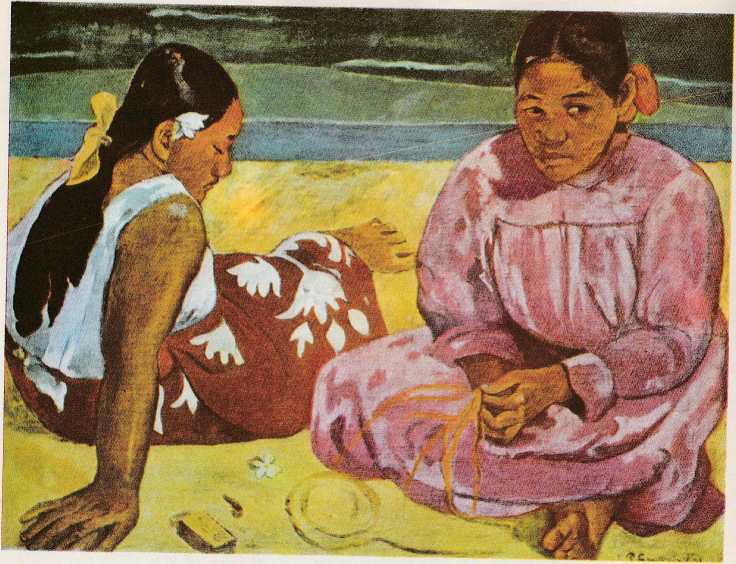
PAUL GAUGUIN (1848—1903) Tahitian Women (On the Shore). 1891, panel, oil, 69 x 91.5
In Gauguin’s work, the multifaceted artistic tendencies of the post-impressionist period are reflected. Gauguin — a student of the impressionist Pissarro — was closely connected with symbolism, influenced by Art Nouveau, fascinated by Japanese prints, and especially by prehistoric, primitive art, resonant with his own aspirations. He sought to express the “eternal mysteries” of life, the primal foundations of the existence of nature and man. In 1891, Gauguin managed to fulfill his dream of living in a country “untouched by civilization”: he went to Oceania, to the island of Tahiti.
“Tahitian Women” is both a discovery of Tahiti, an admiration of its colors, forms, and exotic life. It is also the maturity of Gauguin’s style, monumental-generalized, strong. In the spacious and austere alternation of horizontal color planes, to which space is reduced, and the verticals of massive figures — an unshakable order and an almost stern grandeur. It is softened by the fiery blaze of color from the tropical sun. The unity of man and nature stands immovable in Gauguin’s painting.