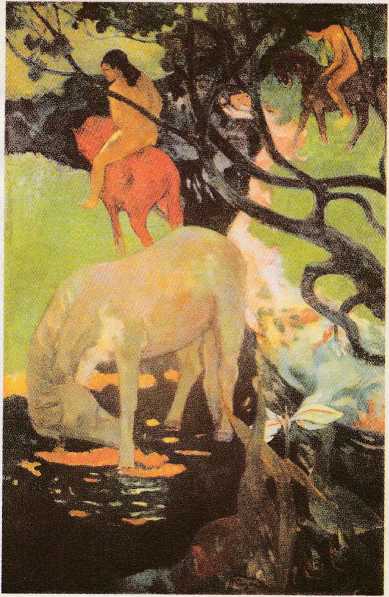
PAUL GAUGUIN (1848—1903) White Horse, 1898, tempera, oil, 140 x 91.5
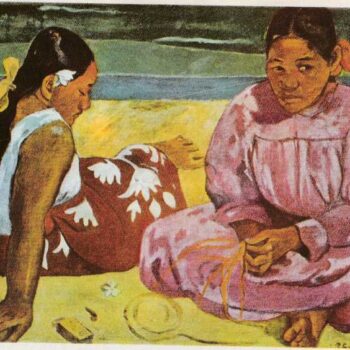
Unlike the Impressionists, Gauguin tried to generalize rather than analyze color impressions from nature. One of Gauguin’s best works, “White Horse,” is constructed not from small separate brushstrokes but from broad colorful planes. Pure bright colors are contrasted and resonate at full strength. They unite with a slow, smooth rhythm of barely perceptible movement: as if obeying a mysterious inexorable law, a powerful flow of colors slowly flows, shimmering from one color to another. In this painting, created during his second trip to the island of Tahiti, Gauguin wanted, in his words, to convey the “mystery of Tahiti,” to recreate “luxurious and unrestrained nature… bushes, streams hidden in the shade… fabulous flowers, that air, fiery and silent.”